The international creditors Greece increasingly doubtful that they come in the remaining days still reach an agreement with the Greek government on fiscal and economic policy reform commitments. The International Monetary Fund (IMF) has his team in the ongoing negotiations with Athens on Thursday initially withdrawn from Brussels.
 Author:. Werner Mussler, economics correspondent in Brussels
An IMF spokesman called “significant differences” with the Greek government as a reason. The Athenian delegation traveled on Thursday after the talks of Prime Minister Alexis Tsipras from with EU leaders in Brussels. The stock markets responded with price losses. The DAX lost in the afternoon, more than half of the previous gains. Bundesbank President Jens Weidmann said in London, the risk of a Greek sovereign default climb “with each passing day”.

 © FAZ
© FAZ
In Brussels as in Washington was, however, stressed that the negotiations were not interrupted. The talks between the creditor institutions, namely the European Commission, the European Central Bank (ECB) and the IMF were, in any case made little progress in the past few days. EU Council President Donald Tusk, President Jean-Claude Juncker and German Chancellor Angela Merkel and French President François Hollande wanted Tsipras therefore make it clear on Wednesday and Thursday in Brussels that he is very fast, so in the coming days, with the creditor institutions on measurable needs some reform and austerity commitments.
In Brussels, the doubt was great if Tsipras has been convinced by the EU politicians. In this case, he could now equip its negotiating team with instructions and return them quickly to the negotiating table. The head of the Euro Group, the Dutch Finance Minister Jeroen Dijsselbloem, said on Thursday in Tallinn, an agreement with Athens was to the meeting of euro zone finance ministers in a week in Luxembourg “technically and politically” possible.
 © Reuters
 Tsipras had to be “a little more realistic,” said European Council President Donald Tusk: “What we need now are decisions, no negotiations”

Tsipras had “a little realistic “be says EU Council President Donald Tusk:” What we need now are decisions, no negotiations “
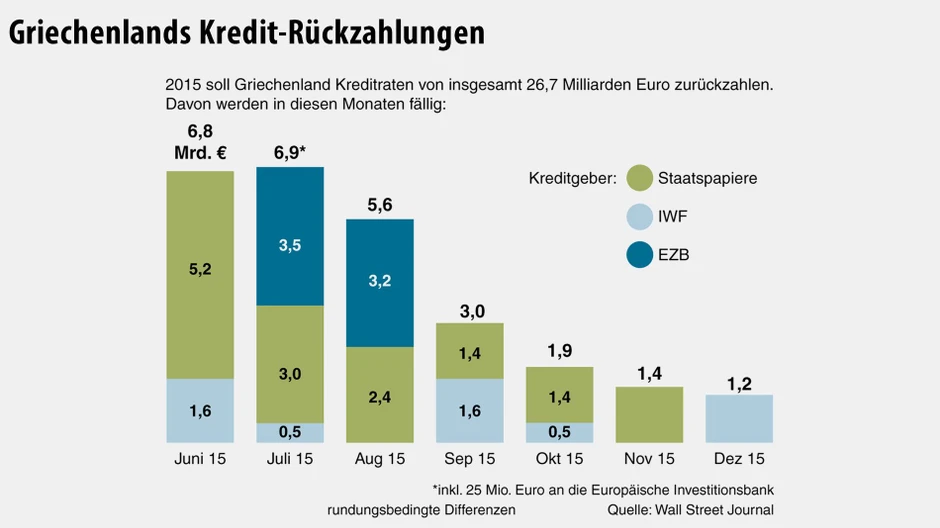
The European interlocutor Athens would be happy if the Greek government nachkäme certain minimum requirements, thus making any commitments to the pension and tax reforms and abgäbe a commitment to a primary surplus (a positive budgetary balance excluding interest payments). An agreement between Athens and the institutions must be up to the meeting of the Euro Group. This could approve ideally the agreement in principle and submit to national parliaments for approval. Shortly before end of the month that EUR 7.2 billion could be released on available assistance loans that would keep Greece once again in front of the national bankruptcy. After end of the month would collapse the money.
Whether it comes to an agreement, but is more open than ever. What is clear is that even with such a solution important issues would be hidden or postponed. So the IMF is entering into a compromise which violated its own rules. Rather, it should demand that the euro countries an assurance that they assume all risks arising from the foreseeable low primary surpluses in the coming years. The IMF can continue to participate only if the Euro States shall ensure that the sustainability of public debt will be restored. The Europeans would therefore have the already very favorable for Athens Interest and repayment terms even further soften -. Or medium ready to declare a haircut
 © dpa
© dpa “The cow has the ice, but it slips from permanently”: Jean-Claude Juncker

“The cow has the ice, but it slips from permanently”: Jean -Claude Juncker
Would
Equally unclear how Greece would finance through June also. It is speculated that the current program is extended again – until March 2016. That would have for the federal government has the advantage that it could postpone a third utility, against the joined forces in the Bundestag. The funding gaps in the state budget were made but at an extension. Very soon would the euro states to decide how they want to fill these gaps. Athens squints to 10.9 billion euros from the existing program, which have hitherto been earmarked for bank recapitalization. Because of all these open questions, the rating agency S & amp has P downgraded Greece further. The rating for long-term debt was lowered to “CCC” from above “CCC +”, told the agency. The outlook is negative.
Read more about
Allows you to acquire rights to this article

<- ========= Confirmation page:.! Will be loaded by JS if submission is successful === ============ ->
.


No comments:
Post a Comment